How to read a crochet pattern. Take a breath. Are you feeling a little lost looking at all those abbreviations and asterisks? Do you stare at a pattern and wonder if maybe everyone else got a secret manual you missed? Don’t worry. We’re going to break this whole thing down together, one little piece at a time, until reading a pattern feels as natural as picking up your hook.
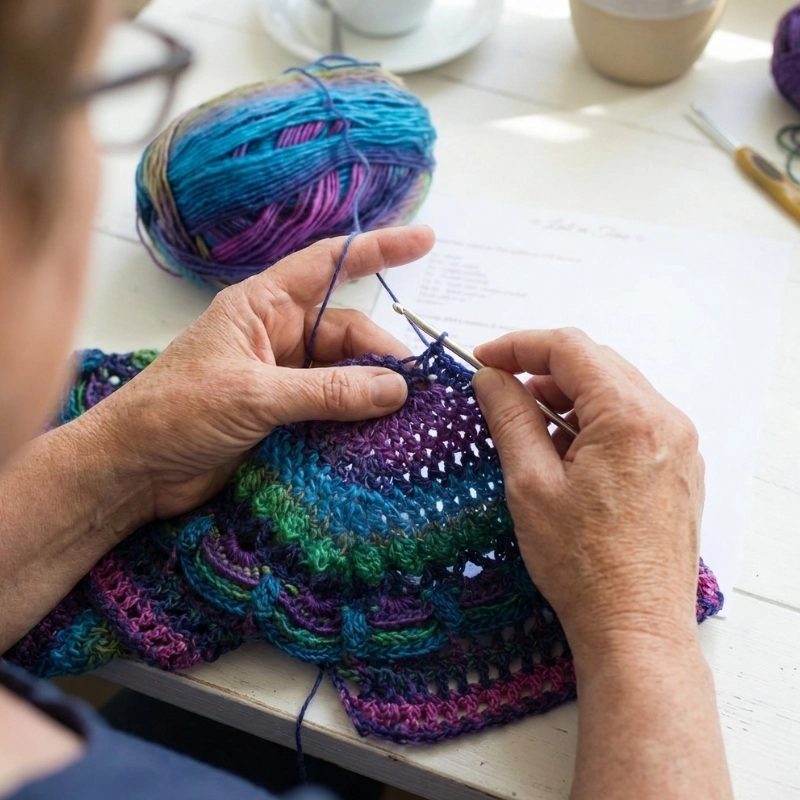
Let me be honest with you. I hear from so many people who picked up crochet from videos on YouTube or TikTok, and that is wonderful. Truly. Learning a craft has never been easier, and I love that so many new hands are falling in love with yarn.
But here’s the thing that breaks my heart a little. A lot of folks reach out to say they don’t just struggle with patterns. They feel like they CAN’T read them at all. And when you can only follow along with a video, you’re stuck in a loop. You can’t try that gorgeous blanket you saw in a magazine. You can’t experiment with a new stitch pattern from a book. And the moment you lose your place or mess up a stitch, you’re scrubbing back through a 45 minute video trying to find the one second where she shows that tricky decrease. Nobody has time for that. You could be crocheting instead.
So today, we’re fixing this. Today is the day you finally crack the code. And I promise you, it is not scary. It is not some mysterious language only experts understand. You can absolutely do this.
My own crochet story started when I was a little girl, learning from my grandmother. She was such a beautiful soul, but she couldn’t read a pattern either, so she couldn’t pass that part along to me. When I was around 10, I spotted a pattern in a magazine for the cutest little bear, and I wanted to make it so badly. I had the yarn. My grandma lived hours away and we definitely couldn’t just video call her back then.
So I sat down, alone, and figured it out. I made the bear. I was so proud of that little thing. If a 10 year old kid could work it out without Google or YouTube or anyone to ask, you can too. Let’s do this together.
How To Read A Crochet Pattern: Start Here
Before we get into the weeds, let’s settle one thing. A written pattern is really just a designer talking to you on paper. That’s all it is. A set of instructions passed from one crocheter to another. If you slow down and take it one little chunk at a time, you’ll understand it. Think of yourself as a detective, cracking a code.
And listen, if you need to rewrite the pattern in your own words to make sense of it, that is perfectly fine. I do this all the time, and I’ve been crocheting for decades. I’ll read a line and think, “Okay, the pattern is telling me this, but what it actually wants me to do is this other thing, and then keep going until I reach the end.” Translating for yourself is not cheating. It’s just being a smart crocheter.
One more thing before we dive in. I’m teaching you how to read patterns written in American English terminology. If you ever pick up a pattern written in UK terms (or any other system), the words mean slightly different things. You’ll get there eventually, but for now let’s keep it simple.
To give yourself the best shot at success, start with commercially published patterns. I’m talking about the kind of patterns you’d find in books, pattern leaflets, or on the back of a yarn label at a big craft store. These patterns have been through an editing process. Several sets of eyes have checked them. They follow industry standards. Once you’ve worked through a couple of those, then you can branch out and try patterns from independent designers. They’re fantastic too, but starting with polished commercial patterns takes a lot of guesswork off the table.
Skill Levels
The very first thing most patterns will tell you is the skill level. Pay attention to this. Be honest with yourself about where you are in your crochet journey and whether you’re in the mood for a challenge or a relaxing Sunday afternoon project. A Beginner or Easy pattern is the perfect training ground for learning to read patterns, because the instructions themselves are usually straightforward.
Here’s a quick breakdown of what the skill levels generally mean:
| Beginner | Projects for brand new crocheters using the most basic stitches. Very little shaping. |
| Easy | Projects with basic stitches, repetitive stitch patterns, simple color changes, and simple shaping and finishing. |
| Intermediate | Projects that use a mix of techniques, such as basic lace or color work, moderate shaping and finishing. |
| Experienced | Projects with intricate stitch patterns, advanced techniques, non-repeating patterns, multi-color work, fine thread, small hooks, and detailed shaping. |
Pattern Details
Right after the skill level, the pattern will give you all the essential details. This is where you’ll find the yarn the designer used and how much of it you’ll need, any notions required (like a yarn needle or stitch markers), the hook size, the finished measurements, and the gauge.
Gauge, by the way, is something I beg you not to skip. I know, I know, nobody wants to make a little swatch before they start the fun part. But trust me, it’s worth the ten minutes.
You’ll also usually find a list of stitches and any special stitch combinations used in the pattern before you get to the actual instructions. Designers generally assume you know the basics like single crochet and double crochet. For anything unusual, they’ll explain how to work it in a little note at the top.
Abbreviations
Patterns are full of shorthand. That’s how they fit onto a page without turning into a novel. Knowing your crochet abbreviations is one of the most important things you can do to make pattern reading easier. Things like sc for single crochet, dc for double crochet, ch for chain, st for stitch, and so on. There’s a standard list used pretty much everywhere. Keep a cheat sheet nearby when you’re starting out, and before long you’ll know them by heart without even trying.
Sizes
When you’re learning to read a pattern, paying close attention to sizing is a really big deal. If you’re making a garment like a sweater or a hat, the pattern will probably give you several size options all at once. For example, it might say something like, “Sizes: S (M, L)” and then later list “To Fit Bust: 32 (36, 40)” and “Finished Bust: 36 (40, 44).”
The pattern will keep going this way throughout. Every time there’s a number that changes with size, you’ll see something like 15 (17, 19). To use this, first decide which size you want to make based on the “to fit” measurement. The finished measurement is what the actual garment will measure once it’s done (usually a bit bigger, which is the ease).
So let’s say I want to make a Large based on those numbers above. That means it’s designed to fit someone with a 40 inch bust, and the finished garment itself will measure 44 inches around the bust.
Here’s a trick that has saved me more times than I can count. When you pick your size, go through the whole pattern with a pencil and circle every single number for your size. Every one of them. That way when you’re halfway through a row and a little tired, you won’t accidentally glance at the Small number when you’re making a Large.
Clothing patterns will also break the project into sections like the back, the front, the sleeves, and so on. Don’t panic when you see this. It’s actually easier than it looks. That said, while you’re still getting your sea legs with pattern reading, I’d stick to easy patterns without multiple sizes. Get the basics down first, then tackle a sized garment.
Pattern Terminology
There’s a little bit of shorthand you’ll see in almost every written pattern. Once you know what each symbol means, reading patterns gets so much easier.
* An asterisk (sometimes you’ll see double asterisks **) marks a spot where the instructions are going to repeat. So if you see something like *dc in next st, 2 dc in next st, repeat from * around, that means you’re going to do a double crochet in one stitch, then 2 double crochets in the next stitch, and keep doing that pattern all the way around the row.
( ) Parentheses are used to group stitches that all go into the same place. For example, if the pattern says (sc, ch 1, sc) in next st, that means you’ll work a single crochet, then a chain 1, then another single crochet, all into the same stitch.
[ ] Brackets and parentheses can also carry little notes to you. So if a row begins with ch 3 (counts as a dc here and throughout), the pattern is telling you that from now on, whenever a row starts with a chain 3, that chain is acting as your first double crochet. You don’t need to make another dc right after it.
Continue in Pattern (or Patt) as Established: Just keep doing whatever you’ve been doing. The pattern has already explained the rhythm, and now it’s telling you to keep going with it.
Finish off or Fasten off: This means you’re done with your current piece of yarn. Cut the yarn, leaving a few inches for weaving in, and pull the tail through the last loop on your hook to lock it in place.
Work Even: Keep going in the pattern without adding or taking away any stitches.
Right Side / Wrong Side: The right side is the side that will be visible when the piece is being used or worn. The wrong side faces in, hidden from view.
Right Front: The right side of a garment as it sits on the body when worn.
Left Front: The left side of a garment as it sits on the body when worn.
Actually Reading The Pattern
Alright. Here we go. Deep breath. You’re going to pick up a pattern and walk through it, one little step at a time. Remember, you’re a detective decoding clues:
Before you start working a row, read the whole thing through first. Pause at every comma. Make sure you understand what each little section is asking you to do.
Look for the repeat, because almost every row has a repeat of some kind tucked inside it.
If the pattern tells you to use a special stitch that was defined at the top, flip back to that section and read the instructions for how to make it. Don’t guess.
Does the language feel clunky or confusing? Translate it in your head. Say it out loud in your own words. Whatever helps it click.
Now pick up your hook and yarn. Work to the first comma. Then to the next. Take your time.
At the end of the row, count your stitches. Do you have the number the pattern says you should have? If yes, celebrate. If no, figure out where you went off and fix it before you move on.
Take another breath and start the next row.
How To Read A Crochet Pattern: Tips And Tricks
Write on the pattern. Please, please write on the pattern. I photocopy mine or print them out so I have a working copy I can mark up freely. My original stays clean, my working copy gets crumpled and scribbled on, and that’s exactly how I like it.
Check off rows as you finish them. There is nothing worse than pausing mid project and trying to remember where you left off.
Make your own translation notes. For example, if the pattern says R9-13: sc around, I’ll write a big “5” next to it in the margin so I know that’s five rows of single crochet. Then I tick each one off as I go.
Use a scrap piece of contrasting yarn to mark the beginning of each round. This little trick has saved me from so many counting disasters, especially when working in a spiral.
Count after every round. Even if the round felt easy. Especially when the round felt hard.
Hunt for the repeat. Most rows have a little starting bit, a big middle section that repeats, and a little ending bit. Once your brain sees that structure, the row gets so much less intimidating. Read the whole row first. Pause. Do the starting bit. Do your repeats. Check the pattern for how to finish the row.
It is completely okay to slow down. When I’m working something complicated, I’ll crochet three or four stitches and then stop to make sure I’m on track. There’s no prize for speed, friend. Accuracy wins every time.
If things aren’t working out, do not throw your project across the room and declare that the pattern is broken. Nine times out of ten, we’re the ones who missed something. And that’s totally okay, even experienced crocheters misread instructions sometimes. Go back. Re-read. Ask yourself what the row is trying to accomplish overall. That question alone often helps me spot my mistake.
But sometimes, very occasionally, the pattern really is wrong. If you ended on the right stitch but the stitch count seems off, maybe just the count was printed incorrectly. If things are really off and you can’t figure out what’s going on, here’s what you can try:
Look at the row before or the row after to see if you can pick up any clues about what this row should look like. A little detective work goes a long way.
Call or text a crochet friend. Or stop by your local yarn shop and ask someone there.
Post a question in a crochet group on Facebook. Crocheters are some of the kindest people on the internet, and someone will usually jump in to help.
If you bought the pattern, check if you can reach the designer. A lot of them are happy to help you troubleshoot their own work.
If the pattern came from a book, check the publisher’s website for errata. That’s a fancy word for a list of corrections that got printed after the book came out.
How To Read A Crochet Pattern Written In Another Language
I won’t sugarcoat this one. Working through a pattern in a language you don’t speak can be really hard, and sometimes even with all the tricks in the world I just can’t crack it. But it’s worth trying, because some of the most beautiful patterns out there are written in languages other than English. Here’s what I do:
If the pattern lives on a website, I run the whole page through Google Translate. The result can be a little awkward and the stitch names sometimes come out strange, but you can usually get the gist of what’s going on.
Pay close attention to stitch counts. In amigurumi and other pieces worked in the round, you’ll often see a pattern of increases, like adding 6 stitches on certain rounds and working even on others. Tracking those numbers can tell you a lot about the shape of the piece even if the words are confusing.
Study the photos. Really look at them. Sometimes a good photo tells you more than a paragraph of text ever could.
If there’s a video to go along with the pattern, watch it. I usually mute the sound because listening to a language I don’t understand pulls my focus away from what I’m seeing. Watching her hands is what matters.
If all else fails, take a step back and ask yourself what drew you to this pattern in the first place. Is it a certain stitch? A color combination? A shape? Sometimes you can take just that one element and bring it into a different pattern you can actually read. Pinterest is great for this. Type in the element you like (something like “flower granny square” or “bobble hat”) and you’ll find loads of similar patterns, often with clear English instructions.
And see, that wasn’t so scary was it? When you take it slow and work through it piece by piece, you absolutely can learn to read a crochet pattern. I promise.
Now go pick up a pattern that’s been intimidating you, and give it another try. You’ve got this.